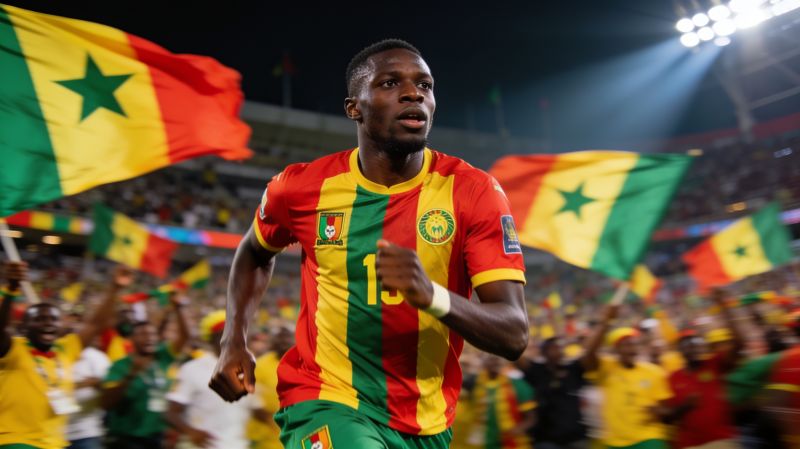
Khalilou Fadiga remains one of Senegal’s most memorable football figures, not because his career followed a smooth path, but because he kept returning to the pitch when serious doubts surrounded his future. In the early 2000s, Fadiga combined a left foot of unusual precision with the restless energy of a street footballer. His rise reached a global audience during Senegal’s remarkable run at the 2002 World Cup, where the team defeated defending champions France in the opening match. Fadiga played with confidence that seemed almost casual. He carried the ball through crowded midfield areas, delivered dangerous set pieces and gave Senegal a creative outlet when matches became tense. That performance turned Fadiga into a symbol of a football generation that refused to accept the old hierarchy of the sport. Supporters remember his long strides and bright personality。but the deeper story is one of resilience, medical uncertainty and a player’s stubborn refusal to be defined by a diagnosis.Fadiga’s route to international prominence was far from direct. Born in Dakar and raised partly in Europe, he developed through clubs in France and Belgium before establishing himself as a dependable attacking midfielder. His strongest years came with Auxerre, where his technical quality became easier to appreciate inside a disciplined team structure. Fadiga was not simply a dribbler searching for applause;he understood when to slow an attack, when to switch play and when to attack the space behind a full-back. Those details mattered when Senegal entered the 2002 tournament with little international expectation. Fadiga scored against Uruguay in the group stage。
a goal that reflected his composure rather than brute force. He controlled the moment, chose his angle and finished cleanly. People close to that Senegal side often describe Fadiga as an emotional engine, a player whose confidence spread through the dressing room even when his own career was moving toward an uncertain crossroads.That crossroads arrived after Fadiga agreed to join Inter Milan. A routine medical examination identified a cardiac abnormality, and the transfer collapsed before he could establish himself at the Italian club. The news carried an unusual cruelty: Fadiga had reached one of football’s grandest stages, only to be stopped away from the pitch. For many players, such a setback might have ended the conversation. Fadiga instead entered a period of monitoring and treatment, working with specialists while continuing to seek a safe return. Bolton Wanderers eventually gave him another opportunity in England. His appearances were limited, and the old rhythm never fully returned。yet the move carried meaning beyond statistics. Fadiga was not pretending the risk did not exist;he was trying to rebuild a professional life under medical supervision. That distinction matters. His comeback was neither a miracle story nor a simple act of defiance. It was a negotiated return shaped by doctors, coaches, family members and a player determined to retain control over his own choices.Fadiga’s later years in English football brought more interruptions, including injuries and limited playing time, but they did not erase the impression he had made in Senegal’s golden period. At Coventry City and Derby County, he appeared in smaller roles, often far from the spotlight that had followed him in 2002. The contrast was stark. A player once associated with World Cup ambition was now managing the practical demands of recovery, selection and form. Fadiga never had the long, uninterrupted European career that his talent suggested。and that fact still shapes debate around his legacy. Some observers see an unfinished story, while others argue that the refusal to disappear is the achievement itself. In stadium conversations, supporters tend to remember the image rather than the injury report: Fadiga gliding down the flank, looking up before crossing, his body language relaxed even when the pressure was enormous. Football often rewards durability more than imagination;Fadiga represented the imagination that durability could not completely suppress.More than two decades after Senegal’s breakthrough in Japan and South Korea, Fadiga continues to occupy a distinctive place in African football memory. His career offers no tidy lesson about talent being rewarded in proportion to effort. It shows something less comfortable and more credible: sporting lives can be redirected by medical findings, institutional caution and plain bad timing. Fadiga’s name survives because his best football was vivid, but also because his response to adversity was public and human. He accepted scrutiny, endured disappointment and returned when many people believed the risk had closed the door. Younger Senegalese players grew up seeing that a national team could challenge established powers, and Fadiga was among the figures who made that belief visible. His legacy is therefore larger than a transfer that failed or a tournament that ended in the quarter-finals. Fadiga stands for a particular kind of courage。
measured not by ignoring fear, but by confronting it without surrendering ambition.